Source: https://poets.org/poem/student-who-used-ai-write-paper
It’s likely that many of you have already seen this poem by J. Fasano. It’s been shared widely on social media, and likely used in several schools. I think the poem hints at an important point that is often missed in discussions about so-called “AI” and education (note: we should probably use the term “large-language models” – LLMs – instead of AI since “intelligence” isn’t the right term).
Many schools and districts are working on professional learning sessions and documents for students and parents about how “AI” should and shouldn’t be used in teaching and learning. This is important and complicated work: administrators and teachers have to make room in their already packed to do lists to try to find accurate sources about what large-language models do, and the ethics (and sometimes, legalities) involved in those functions within the context of their board policies and current district practices. Here are three examples:
- Some districts have impressive, comprehensive documents that include a high level of detail and advice. However, sometimes these documents repeat inaccurate claims about LLMs, like “Imagine you’re trying to teach a computer to understand and generate human language, just like how you learn to read, write, and have conversations. Large language models are like super-smart virtual assistants…” are inaccurate and misleading.
- Other authors produce more concise “do and don’t do” lists, which might be easier for teachers, parents, and students to digest. But concise lists struggle to cover the thousands of different possible uses in real classrooms.
- Academic sources dive deep into topics like “AI Skepticism” (for the record, I think I’m a member of the “Cognitive Science Wing” and “AI in Education Skeptics”) and how LLMs might play a role in spreading misinformation when they are used inappropriately as a web search tool. This scholarship is potentially useful and important, but few teachers or administrators have time to wade through it all.
I propose a different approach to this work: maybe what we need is an overall idea or principle about what role we want LLMs to play in teaching and learning, and that idea can be a “litmus test” we use when we make these decisions. Here’s the litmus test I propose: whose thinking are you replacing?
Context: one of the most useful areas of research about teaching and learning is memory theory (some great summaries of this research: Deans for Impact, S. Chew, and my attempt). There is a LOT to discuss in this area of research, but one of the most important generalizations is that the more teachers can get students thinking in complex ways about important topics, the more students are likely to learn (i.e. encode new information/skills and retrieve them later when needed).
This general principle can be a useful lens to use when making decisions about how LLMs should and should not be used in education, and when planning professional development. Since learning is the result of thinking, we should figure out what thinking the LLM is replacing and whether that is in the service of learning or works against learning. Whenever we consider whether an LLM might be an appropriate tool for a learning task, we should think about what thinking we need to do and what thinking it might be OK to “offload” to an LLM.
A fictional example: Mrs. Vandervoort is deciding whether to allow students to use Google’s Gemini tool during an essay writing process about themes in Toni Morrison’s The Bluest Eye. The teacher thinks about what thinking she needs students to do to learn the target skill: students need to think about the book, identify a key theme explored in the book, and use evidence to explain their choice. If students use an LLM as part of this assignment, the LLM replaces the necessary thinking students need to do about evidence in the book and the theme, so she decides to not allow them to use an LLM as part of this assignment.
Administrators and teachers could keep the question “what thinking is being replaced?” at the heart of discussions about how LLMs should be used during learning, and design professional development experiences that help teachers use this litmus test question in the context of their teaching decisions. One of my favorite quotes about learning comes from Daniel Willingham: “Memory is the residue of thought.” If we want to learn and remember, we usually have to do our own thinking instead of asking an LLM to do the important parts.
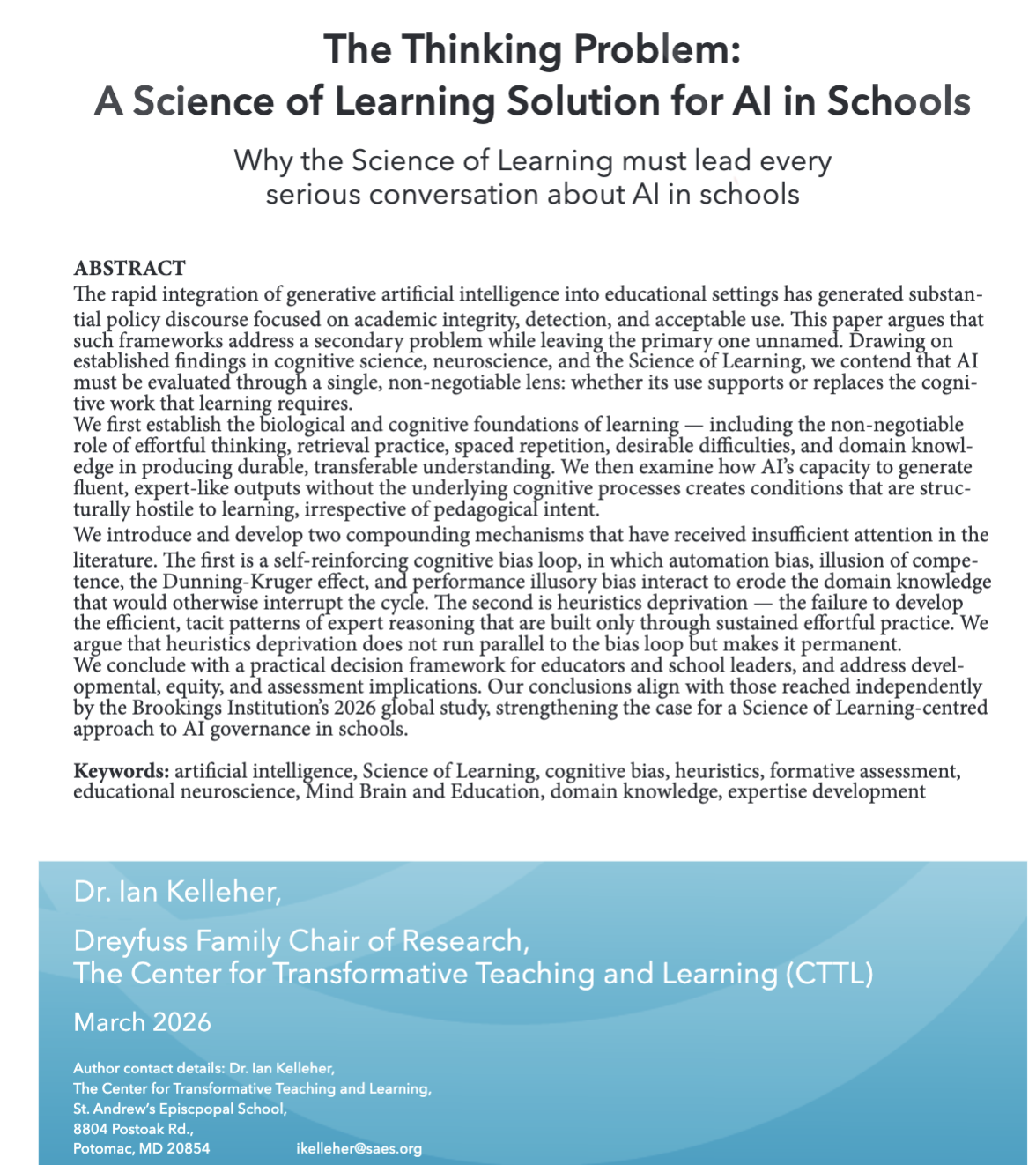
UPDATE: Ian Kelleher wrote this fabulous deep dive about aspects of cognitive offloading and implications for teaching and learning: The Thinking Problem